
How to Treat Headaches from Misplaced Crown Pain: Causes and Symptoms
If you’ve had a crown placed and suddenly can’t shake a headache that radiates from your jaw, temples, or neck, the crown is the most likely culprit. A dental crown that sits even a fraction of a millimeter too high disrupts your natural bite, forces your jaw muscles to compensate, and triggers a chain of tension that reaches your skull. The good news: this is fixable, usually in a single dentist visit.
A misplaced crown causes headaches primarily through bite misalignment. When your upper and lower teeth don’t meet correctly, your temporomandibular joints (TMJ) absorb the imbalance. This overloads the masseter and temporalis muscles, the very muscles that wrap around your jaw and temples — producing a referred headache that can feel identical to a tension or sinus headache.
Treat headaches from a misplaced crown with ibuprofen or acetaminophen for short-term relief, a cold compress on the jaw, and a soft-food diet. Long-term, see your dentist for a bite adjustment. The crown needs to be reshaped or rebonded so your bite is level again.
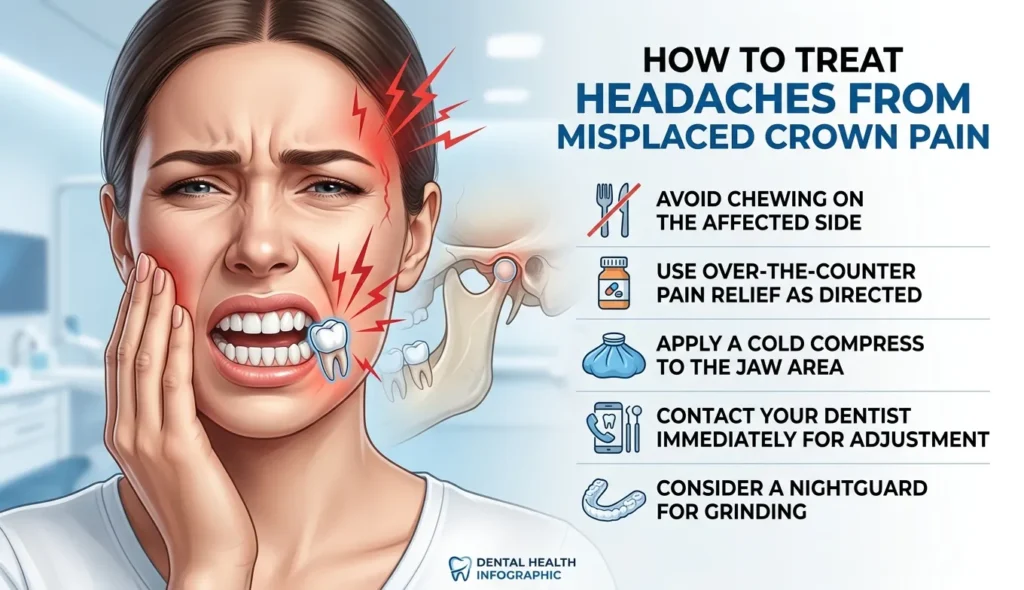
Why does a dental crown too high cause head pain
Your bite is calibrated to within fractions of a millimeter. When a crown is even slightly too tall, every chew, clench, or jaw movement sends uneven pressure into your TMJ. Over hours and days, the surrounding muscles fatigue and spasm
High bite point: Crown contacts before natural teeth, overloading one side
Muscle tension: Masseter and temporalis muscles fatigue and spasm
TMJ strain: The joint absorbs misalignment, causing inflammation
Referred pain: Pain travels to the temples, forehead, neck, and ears
This is why a headache after dental crown placement is often misdiagnosed as stress or sinus pressure — the source (your bite) and the symptom (your head) feel disconnected.
Signs your crown is the cause
- Headache that started within 24–72 hours of crown placement
- Pain that worsens when chewing or clenching
- Jaw feels “off,” or one side feels higher than the other
- Tooth sensitivity around the crowned tooth
- Ear pressure or neck stiffness alongside the headache
- Pain that doesn’t respond to typical headache remedies
How to relieve a headache from a bad crown right now
These remedies reduce pain while you arrange a dentist visit. They treat the symptoms, not the root cause, which is always the crown height itself.
1. Over-the-counter anti-inflammatories
Ibuprofen (400–600mg with food, every 6–8 hours) is the most effective first-line option because it reduces both pain and joint inflammation. If you can’t take NSAIDs, acetaminophen works for pain but doesn’t address the inflammatory component.
Pro tip: Take ibuprofen before bed if you clench your teeth while sleeping. Nighttime clenching on a high crown accelerates muscle fatigue and can turn a mild headache into a severe one by morning.
2. Cold compress on the jaw
Apply a cold pack wrapped in a cloth to the side of your jaw for 10–15 minutes, 2–3 times daily. Cold reduces swelling in the temporomandibular joint and numbs the overworked masseter muscle, giving fast but temporary relief.
3. Soft-food diet
Eliminate the chewing load on the crowned tooth while the joint recovers. Stick to yogurt, eggs, soups, mashed foods, and smoothies. Avoid hard, chewy, or crunchy foods — they amplify the misalignment pressure with every bite.
4. Saltwater rinse
A saltwater rinse after crown placement (half a teaspoon of salt in warm water, swish gently for 30 seconds) reduces gum inflammation around the crown margin. This won’t fix the bite, but it prevents a secondary source of pain from complicating the picture.
5. Jaw relaxation exercises
Consciously relax your jaw throughout the day — teeth slightly apart, lips lightly closed. Many patients unconsciously clench in response to bite discomfort, which worsens the muscle tension cycle. Set phone reminders to check your jaw position every hour.
The real fix: a bite adjustment from your dentist
Home remedies are a bridge, not a solution. The only true treatment for a dental crown too high is a bite adjustment, a quick in-office procedure where your dentist uses articulating paper to map exactly where the crown is making early contact, then gently reshapes the high point using a polishing bur.
| Procedure | What happens | Time | Urgency |
|---|---|---|---|
| Bite adjustment | Dentist shaves down the high point on the crown | 5–15 min | First step |
| Crown rebonding | Loose crown re-cemented in correct position | 30–45 min | If loose |
| Crown replacement | New crown fabricated with correct dimensions | 2 visits | If shape is wrong |
| Root canal evaluation | Checks for nerve involvement if pain is severe | 30 min | If pain is intense |
Pro tip from clinical practice: Never delay a bite adjustment hoping the pain will resolve on its own. Your muscles will “adapt” by shifting your jaw position, which can create a secondary TMJ disorder that takes months to resolve, even after the crown is corrected. Call your dentist the same week.
When crown pain spreads to the head is a red flag
Most post-crown headaches resolve within 1–2 weeks of a bite adjustment. These signs suggest something more serious that requires prompt evaluation:
- Severe, throbbing pain that doesn’t respond to ibuprofen — may indicate pulpitis or nerve damage requiring root canal treatment
- Swelling of the gum, cheek, or jaw — potential abscess or infection under the crown
- Headache accompanied by fever — sign of spreading dental infection; seek care the same day
- Pain that radiates to your ear, neck, and shoulder — advanced TMJ disorder or referred pain from a compromised nerve
- Crown that feels loose or moves — cement failure; the crown needs to be rebonded before further damage occurs
Misplaced crown jaw pain and TMJ: the connection most patients miss
A poorly fitted crown causing head pain almost always involves the temporomandibular joint, even when jaw pain isn’t the primary complaint. TMJ disorder from dental crown misalignment develops when the joint absorbs uneven bite forces over days or weeks. Left uncorrected, this can trigger:
- Clicking or popping sounds when opening the mouth
- Limited jaw opening range
- Chronic tension headaches that persist even after crown adjustment
- Tinnitus (ringing in the ears) in severe cases
If your headache and jaw pain persist after a bite adjustment, ask your dentist for a TMJ evaluation or a referral to an oral and maxillofacial specialist. A night guard may also be prescribed to protect the joint while it heals.
How long do headaches from crown placement last?
With a proper bite adjustment, most patients see significant headache improvement within 24–48 hours and full resolution within 3–7 days. Without correction, the pain typically worsens over 2–4 weeks as muscle tension accumulates.
Dental crown sensitivity and headache that persist beyond 2 weeks after adjustment warrant a second look — your dentist may need to re-evaluate the crown’s occlusal contacts or check for underlying nerve irritation.
Still dealing with headaches after a new crown?
A bite adjustment is a quick, painless fix. Don’t let a small misalignment turn into a chronic TMJ problem — call your dentist today and ask for a post-crown occlusal check.
Frequently asked questions
Can a dental crown cause headaches weeks after placement?
Yes. If the bite misalignment wasn’t corrected early, the jaw muscles adapt in a strained position — this can cause headaches that emerge 2–4 weeks post-placement, not just immediately after. A bite adjustment is still the right first step.
Is ibuprofen safe to take for crown pain every day?
Short-term use (3–5 days) is generally safe for healthy adults at standard doses. Daily use beyond a week without addressing the crown itself isn’t recommended — it masks a problem that will continue to worsen.
Can I get a crown bite adjustment for free?
Most dentists in the USA include post-placement adjustments as part of the crown procedure at no additional charge, especially within 30–90 days of placement. Always call your placing dentist first.
What if my dentist says my bite looks fine, but I still have headaches?
Request a second opinion from another dentist or a TMJ specialist. Bite misalignments of 0.1–0.2mm can cause significant symptoms but may not be immediately obvious without targeted articulating paper tests. You know your body — advocate for yourself.
What to say when you call your dentist
Be specific: “I had a crown placed on [date] and I’ve had a persistent headache, jaw tension, and my bite feels high on that side.” This signals a bite issue immediately and gets you prioritized for a same-day or next-day adjustment slot — most dental offices treat post-crown complications as urgent follow-ups.